Subscribe to our mailing lists!
Did you know that the vast majority of items are sold by us through our targeted e-mail mailing lists?
You can sign up for this mailing lists free of charge.
Do you want that?
Click then below for the application form to be completed by You
The history of Rozenburg Earthenware, plateel and eggshell part 2/3
Publication November 2009 Art & Antique Journal COLLECT
Text: Peter van Ardenne Translated from Dutch by: Peter Boel
Rozenburg eggshellporcelain
The Rozenburg pavilion at the World Exhibition in Paris, 1900, had a surprise in store for its visitors. On the right the well-known pottery had been put on display, but on the left, under a sign that said 'porcelaine', an elegant new product was glittering: eggshell porcelain
The wafer-thin objects with their ethereal decorations made a great impression, and within a year they were in great demand. Still, in the end it wasn't a commercial success. The purchasing costs and the breakability of the material turned out to be stumbling-blocks, and probably most services and vases chiefly served as decorative objects. This was a blessing in disguise, as it meant that a number of objects remained intact for collectors.
A new course
The Netherlands have a long tradition in earthenware and porcelain. Already in the seventeenth century, the city of Delft was famous for
its pottery; in the eighteenth century, Amsterdam, The Hague, Weesp and Loosdrecht followed suit with porcelain. At the end of the
nineteenth century, under the influence of Arts and Crafts and Jugendstil, interest in ceramics flourished, and countless delftware
factories saw the light of day. In 1883, W.W. von Gudenberg (1855-1930) established the N.V. Haagsche Plateelfabriek Rozenburg in
The Hague, a factory that produced art pottery for both decorative and everyday use.
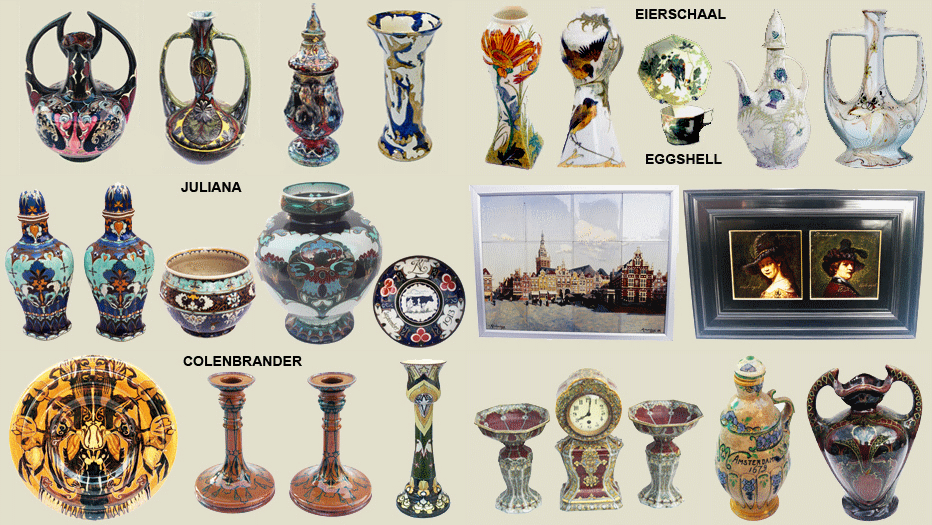
The factory made, amongst others, vases and plates, decorated with floral Jugendstil motifs, which, with their predominantly dark
and subdued colours, bore resemblance to the work of Fayence-en Tegelfabriek Holland in Utrecht and Wed. N.S.A. Brantjes en Co. in
Purmerend. The factory also supplied naturalistic illustrations such as large-format tile plates and tile pictures for the decoration of buildings.
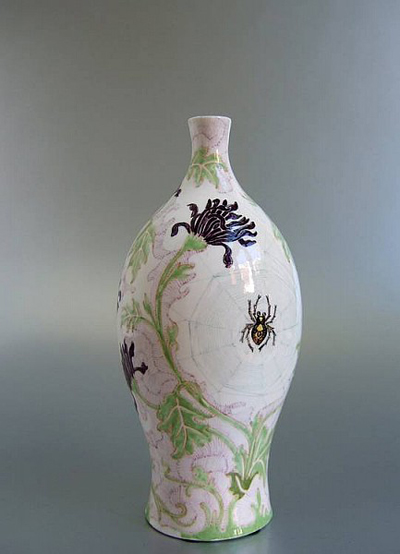
Left: Roelof Sterken, 1903; 6.3 inch vase, with a rare relieved surface of a spider in its web, between purple spider chrysanthemums.
One year after the establishment of the factory, Th.C.A. Colenbrander (1841-1930) entered service as an 'aesthetic leader'. This man, who is quite generally regarded as the greatest innovator in Dutch art pottery in that period, was originally an architect. He made the delftware factory in The Hague famous with his stylized decorations in bright colours, which were applied on a white or cream background. Also, the models he designed often had remarkable shapes: for instance, profiled vases and 'mugs' with pointed, onion-shaped or turban-shaped tops. In 1889, Von Gudenberg was fired by the board of directors. Colenbrander also left, and wandered around for a while. After working for the Plateelbakkerij Zuid-Holland in Gouda he ended up in Arnhem. Here, some of his friends and admirers established a delftware factory called Ram in 1920, where he concentrated on decorating vases with fanciful motifs in blazing colours. Six years after his resignation from Rozenburg, during which several directors had come and gone, the vacancy was filled by the appointment of J.J. Kok. This architect, born in 1861 in Rotterdam as Jurriaan Kok and called Jurriaan Jurriaan Kok from 1899 onwards, had received his education at the Polytechnische School in Delft. He formed a company with a colleague in The Hague, through whom he came into contact with Rozenburg. There he became an aesthetic advisor in 1894. In that year he already acted as a director for all practical purposes, and one year later his official appointment as general director followed. He had a clear vision of what he wanted to achieve: he wanted to return to the original aims of the delftware factory, which had petered out somewhat after Colenbrander's departure and due to the commercialisation of the Rozenburg products. In order to achieve this goal, he left the trodden paths and started developing new models, made of new material: eggshell porcelain.
Porcelain or pottery
Eggshell porcelain is named after the skin of the shard, which is so extremely thin that it is slightly transparent. Many experts have racked their brains over the question whether the material was real porcelain. Originally it was assumed that the pigments of the decorations couldn't withstand temperatures of over 1300 degrees C. This led to the conclusion that the material must have been baked at lower temperatures, and could therefore not be porcelain. Porcelain - which first got its name from Marco Polo (1254-1324) - was already developed in China in 600-900 AD. The production method of this popular material had been shrouded in mystery for centuries, and Europe had to rely on import from Asia until, in the early 1700s, J.F. Bottger invented the European hard-paste porcelain. Notably, this variety was baked at much higher temperatures than the Chinese material: 1370-1460 degrees C against 1000-1320 degrees C. Not everyone was charmed by this hard-paste porcelain (which the English call Dresden China) and in a number of countries softer material was developed, which - after the Chinese example - was baked at lower temperatures, e.g. in Scandinavia, in France (Pate Nouvelle) and in England (Bone China). After a few failures with Bone China, Kok started to experiment with a material that had been developed by Prof. Dr. H. Seger in Berlin. Which of the two types of porcelain clay he actually used is not entirely clear, but in the factory archives the composition was found: 19% Cornwell stone, 31,6% china clay, and 49,4% bone meal. With information from that same archive, 'Kok's secret' was also unlocked. In order to better conserve the decorations, he turned the traditional process around, ordering the biscuit heating (of the bare shard) to take place at very high temperatures, up to ca. 1500 degrees C, while the polish heating (of the glazed shard) took place at a lower temperature. Ergo, we can qualify eggshell porcelain as porcelain, on the grounds of the baking temperatures.
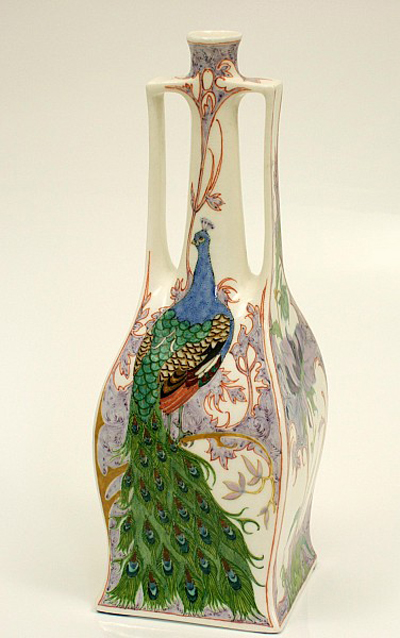
Right: Samuel Schellink, 1911: 7.5 inch vase, with two ears and a decoration of a peacock on a branch with purple and blue poppy flowers.







 Back to top of page